Utena Fansub Ep 9 Translation Notes
Revolutionary Girl Utena Episode 09 The Castle Said To Hold Eternity.mkv
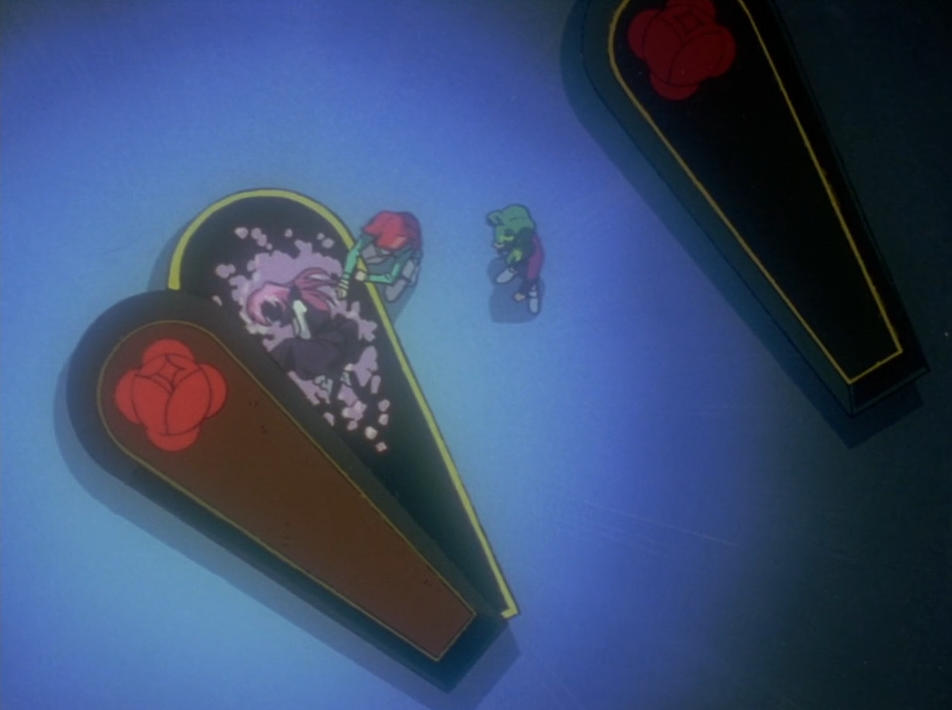
しつこいのは一番嫌われるんだぜ、先輩
Stubborn people are the most hated, Sempai. (from ohtori.nu)
Learn to take a hint, vice president. (my translation)
I thought I’d talk about this line because my translation differs quite significantly from a literal translation. The ohtori scripts’ translation shown above attempts to translate the line more literally, and I think suffers greatly for it.
Let’s break down the line: しつこい is an adjective that’s used to describe people who won’t take no for an answer; connecting it to the particles のは make it describe an implicit (but missing) noun - that noun being “people”. The ohtori script chooses to translate it as “stubborn”, but I can’t help but feel this doesn’t capture the implications that しつこい has about harrassment. In fact, I couldn’t think of a good English adjective at all, which made me start thinking about alternative ways of translating the line.
Then Utena says 一番嫌われる. This means “are hated the most”. On top of the inadequate translation of しつこい, a direct translation of this creates an unnatural sounding turn of phrase. While attempting to rephrase it in a way that sounded okay, I realised I was better off trying to retranslate the line as a whole.
My translation’s number one goal was to preserve Utena’s passive aggressive suggestion that Saionji is harrassing Anthy. I think that’s the most important thing the audience should have been taking away from the Japanese, so it should be what they take away from my translation as well. “Learn to take a hint” doesn’t explicitly say that “if you keep bothering someone after they tell you No, they’ll just hate you more”, but it does heavily imply it, which I think is sufficient.
The final thing I want to say about this line is how I translated “senpai”. Previously I’ve translated it as the character’s name, but here I translated it as “vice president” instead of “Saionji”. This is because I think it’s important to preserve the fact that Utena is standing up to someone with more power than them. There was also reference to Touga being the president in a line just 1.5 minutes prior, so it reinforces some of the power dynamics between those two as well.
—–
君の王子様っていうのは…俺みたいなやつじゃなかったか?
Your prince was just like me, wasn’t he?
I struggled a lot with this line. Touga either truly believes he is Utena’s prince based on his memory of the church, or he doesn’t know for sure but he’s trying to manipulate them into liking him anyway. Either way, he’s not just posturing to Utena and making himself out to be a prince here… he’s making himself out to be THE prince. He’s strongly suggesting that he’s the one from her memory. It was tough to find a snappy English translation that had the same strong suggestion while still staying implicit. I originally had “I remind you of your prince, don’t I?” but decided that it wasn’t a strong enough implication, and spent another long while trying out synonyms and rewording things until I came up with the translation I settled on: “Your prince was just like me, wasn’t he?”
—–
やつはいつも俺より先に、俺の知らない世界に行く
He was always one step ahead of me, into a strange world I didn’t know.
I don’t have much to say about the translation itself for this line (it’s a pretty straightforward direct translation), but my god this line gives me chills. I think it may be a metaphor for puberty and “maturity”. I put maturity in quotes because when it comes to these two characters, I think they both see maturity as how much of a patriarchal man you are.
—–
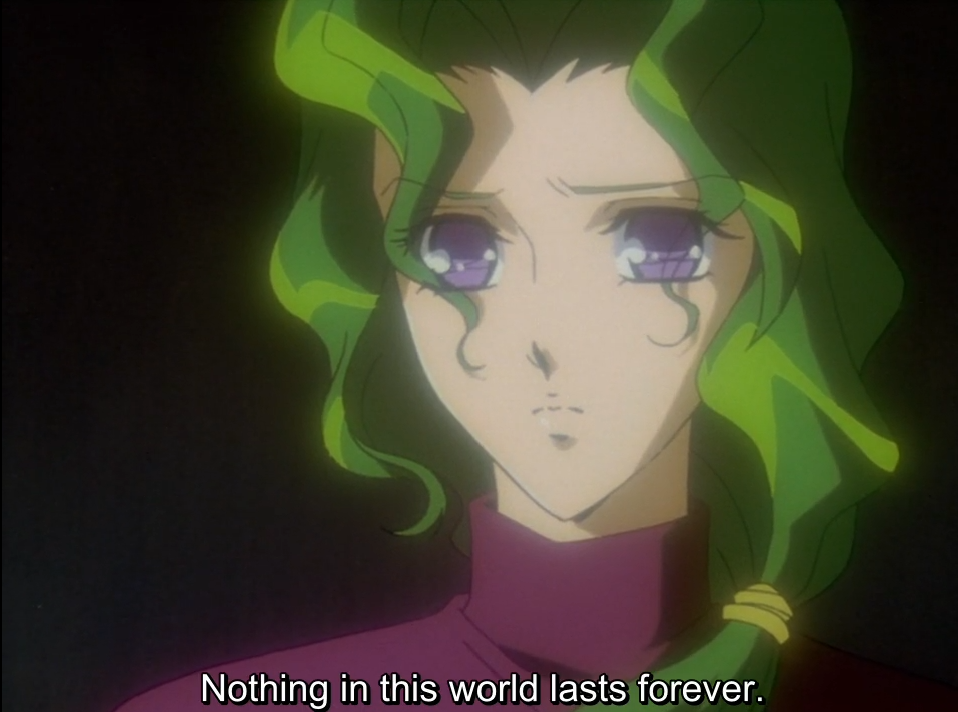
Utena: 生きてるなんて、気持ち悪いよね。
Touga: そう?
Utena: うん、気持ち悪いよ。どうせ死んじゃうのに、どうしてみんな生きてるんだろう?なんで今日までそのことを気づかなかったんだろう?永遠の物なんてあるわけないのにね。
Saionji: 永遠の物?
(below translation is from ohtori.nu)
Utena: Being alive is kind of sickening.
Touga: I see…
Utena: It’s sickening… Why does everyone go on living knowing they’ll end up dying anyway? I wonder why I never realized that until today. Eternity couldn’t possibly exist, could it?
Saionji: Eternity?
(below translation is my own)
Utena: Living feels wrong.
Touga: Really?
Utena: Yeah. It feels wrong. Everyone dies in the end. Why do they bother living? Why didn’t I realise before today? Nothing in this world lasts forever.
Saionji: Nothing lasts forever?
As I’ve discussed previously, I decided early on that I would not be translating 永遠 directly as “Eternity” every time it appears. I think the theme of not wanting things to change is strong enough throughout the show that it doesn’t need to be carried by a recurring word. I’m translating it the way that flows best each time.
Utena’s bolded line literally means “permanent/eternal things don’t exist” or “there’s no such thing as something permanent/eternal” (little side note, this uses the same Japanese grammar as Juri’s “there’s no such thing as miracles”). This was actually a very easy translation. The first time I watched it, almost without thinking, I translated it as “Nothing in this world lasts forever” in my head. I think it flows super well, it works as dialogue from a small child, and captures the sadness of Utena’s loss perfectly.
However, the line does contain the words 永遠の物 (often translated as “something eternal”) and I can see how some might argue for translating this more directly, since the same phrase is used by many other characters to describe what lies inside the floating castle. I just don’t think that the upsides of this (consistent phrasing) outweigh the downsides (less natural, less thematic, less poignant). If little baby Utena suddenly starts talking about capital E Eternity, it makes her seem almost like she’s privy to more of the weird lore than she actually is. It makes much more sense for her to use a phrase that a child might genuinely use if their parents had died.
—–
As always, thanks to @dontbe-lasanya for their fantastic editing (and words of encouragement)!
Be sure to follow for updates! For all episodes released so far, go here: