Utena Fansub Ep 10 Translation Notes
Revolutionary Girl Utena Episode 10 Nanami’s Precious One.mkv
The start of this episode where Saionji is expelled has a lot of very Japanese talk of shame, responsibility, 面倒 (mendou: care/burden), etc. Many of the turns of phrase sound funny when directly translated, so it makes more sense to rephase the sentence into something more familiar. Here’s a lightning round of 3 lines and their various translations. Hopefully based on the colour coding you’ll be able to see where and why I made the choices I did.
破廉恥にもほどがある
Is there any limit to his shame? (from ohtori.nu)
Is there no limit to his shamelessness? (from internet archive)
How desperate can you get? (my translation)
Said by Juri. 破廉恥 means “shameless, disgraceful”. にもほどがある kind of means “it’s an understatement to say X” or “is there a limit to X?”. I think talking of “shame” in this sense is distinctly Japanese. If Juri was an English speaker I think she would come at the behaviour from a different angle — desperation.
この上、面倒かけて悪いんだが…
Sorry to further burden you… (from ohtori.nu)
I’m sorry for all the trouble I’ve caused you. (from internet archive)
I hate to ask another favour of you, but… (my translation)
This from Saionji — a literal translation would be “on top of everything, I’m sorry for burdening you with another thing”. This is just before he shows Touga the exchange diary to give back to Anthy. Interesting to me that the Internet Archive subs don’t mention that he’s asking a new favour.
俺は責任持って渡しておくよ
I’ll take responsibility for delivering it to her. (from ohtori.nu)
I’ll take care of it for you. (from internet archive)
I’ll personally see to it that she receives this. (my translation)
責任持って literally means “hold onto the responsibility and…” which sounds better as “take responsibility for…” but I think it sounds even better completely rephrased. Side note: The Internet Archive subs make another interesting decision here. “Take care of” is ambiguous and makes it so that Touga isn’t outright lying (since he immediately incinerates the diary). But he literally does lie in Japanese, he says he’s going to hand it over.
—–
やはり、女の子は王子様にはなれないのでしょうか。
Should have known, a girl can’t become a prince… (from ohtori.nu)
Maybe a girl really can’t become a prince… (from internet archive)
Maybe girls can’t be princes after all. (my translation)
A classic translation foible: translating やはり as “as expected” or “I should have known”. Of course it can sometimes be translated as that, but in many contexts that translation doesn’t make sense. My vibe read of やはり is that it signifies that the speaker is reflecting back to a past state of mind. In some cases, this is thinking back and realising you were right all along, hence “as expected” as a common translation. But in some cases, like this one, you’re thinking back and reconsidering that you may have been wrong. I guess this is what the “should have known” translation is trying to do, but it’s not as strong as that. The English phrase “should have known” is almost berating yourself for not knowing, whereas the Japanese やはり is not nearly as self-deprecating. It just shows that you’re reflecting and reconsidering.
—–
目障りなのよあんた達。いつもお兄様の周りにうろちょろと。
You two are an eyesore, always hovering around my brother. (from ohtori.nu)
You’re both eyesores, always hanging around my brother. (from internet archive)
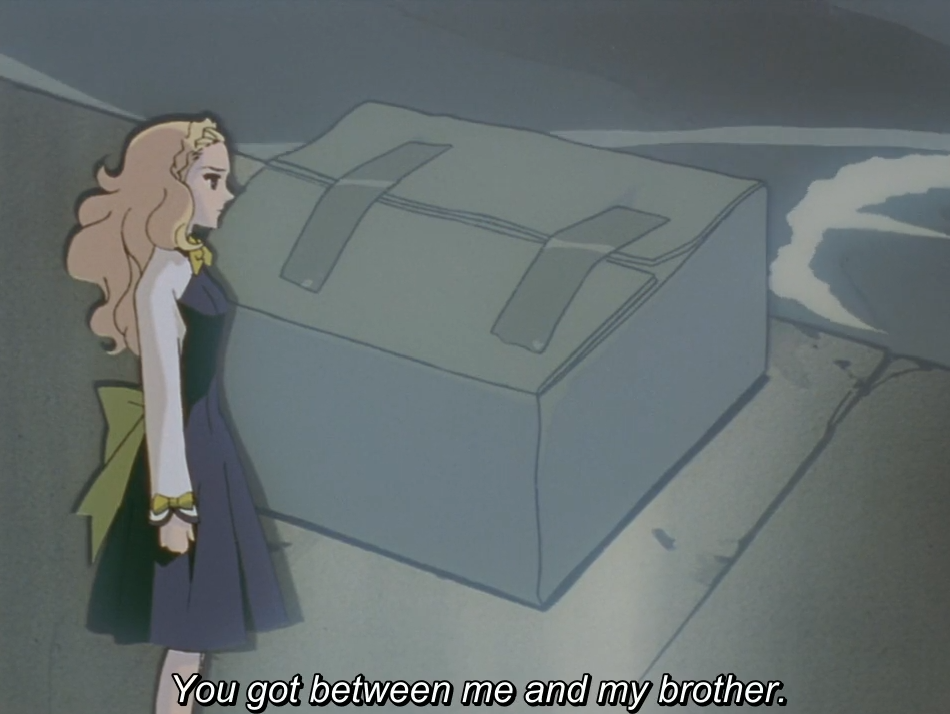
You two sicken me. Always dangling off my brother like parasites. (my translation)
It’s sad that these other translations used “eyesore”. Technically that’s what the word means, but I’m being completely honest when I say I’ve literally never seen or heard the word “eyesore” outside of an anime translation. I really, really hate the word “eyesore”. In my mind it’s the very essence of poor translation.
What does 目障り actually mean? It’s a compound word — 目 is “eye” and 障り is “hinderance”, “obstruction” or “sickness”. It basically just means “I can’t stand the sight of you”. So I translated it as such: if someone “sickens you” then you can’t stand the sight of them. This plays into the second half of the line.
I took a few liberties with the second half. うろちょろ is an onomatopoeic word for like, pottering around, loitering, hovering without doing anything. I actually like this part of the translation from the ohtori script, “hovering” is a great word. お兄様の周り can mean “around my brother” or “in the vicinity of my brother”. I believe Nanami is trying to get across the idea that Utena and Anthy have nothing better to do than hover around Touga. The problem was that the “hovering around” phrasing didn’t feel visceral enough to go with “sicken me”. I could have reworded the first half (”I can’t stand you two”), but I really liked how emotionally charged the line felt, so I doubled down on it.
—–
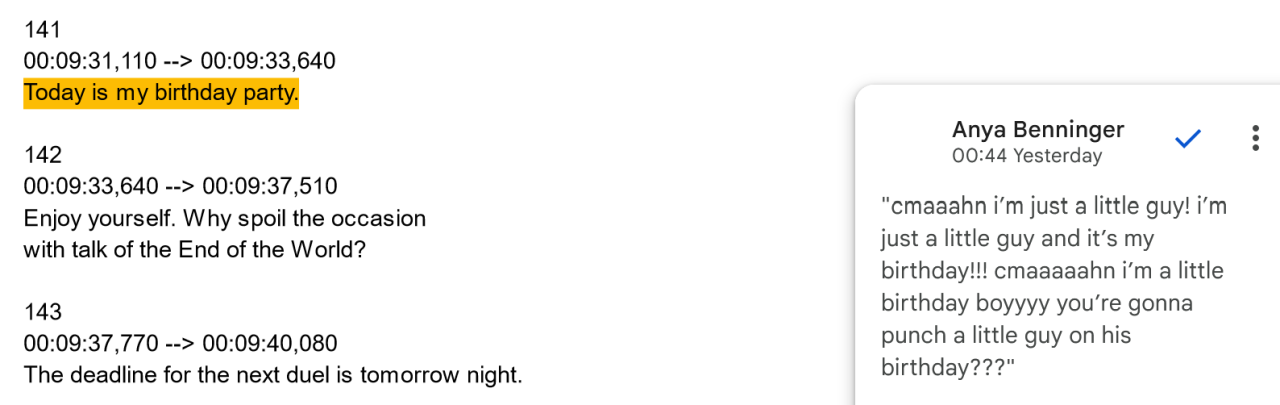
Thank you to @dontbe-lasanya for some very nice changes this episode on some lines I was really struggling to phrase naturally! And for this comment lol
Follow to see new episodes as they release! Go here for all past episodes: