Utena Fansub Ep 36 Translation Notes
Revolutionary Girl Utena Episode 36 And The Doors Of Night Open.mkv
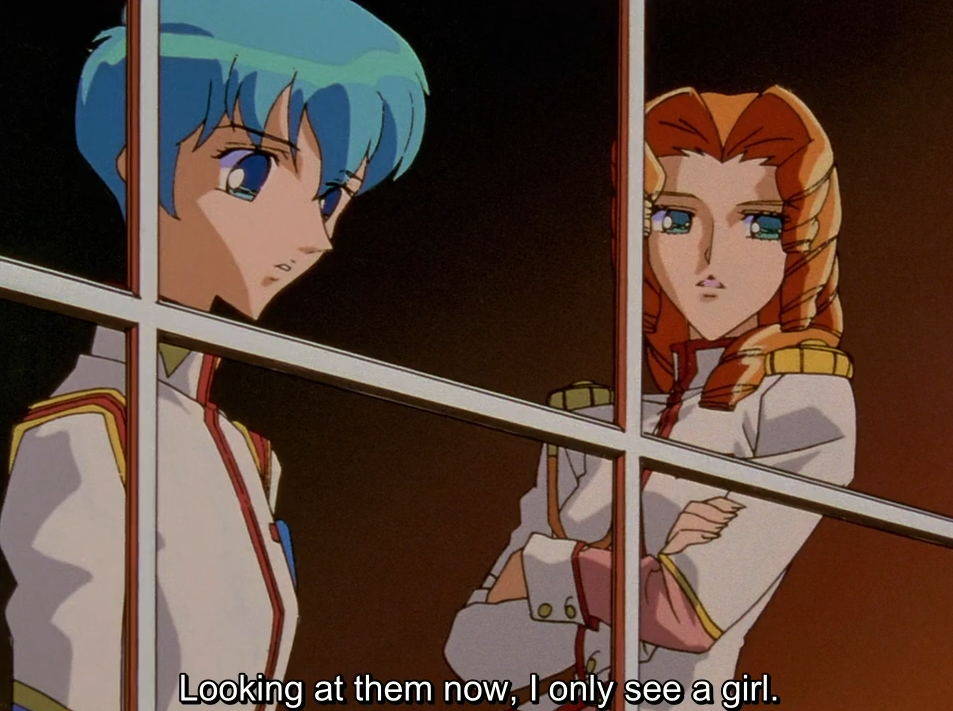
At the beginning of this project, I mentioned that I was choosing to give Utena they/she pronouns for two reasons. One was to show that as the student council loses to Utena one by one, they slowly begin to understand Utena’s identity. I’ll discuss this more in the notes for the next episode. The other reason was to make up for Utena’s use of the untranslatable Japanese first person pronoun, 僕 (boku).
A quick aside on this actually. After reading my posts on the matter, several people have asked me if I’ve heard of ぼくっこ (bokukko, a girl who uses boku), and have said that Utena is a prime example of one. I could not disagree more vehemently. To say so is to wildly miss the point of the series. Utena is protrayed as fitting in this trope to begin with, sure, but that is only to make the commentary on their gender so much more poignant. It’s putting Utena’s gender in a box when the series shows how they revolutionise the world by refusing to conform to a box. It’s oversimplifying and ignoring the quite overt nonbinary themes and messaging. If you think you understand Utena’s gender as “just bokukko”, you have missed so much of what the show has been trying to say.
Back to my original point — since I couldn’t translate boku, I needed to compensate in other ways, and one of these ways was by using English pronouns. And I think this scene is the one that has been most affected by that choice so far.
Juri: なぜかな。私には今彼女は女の子に見える。
Miki: 天上先輩は女性に決まってるじゃないですか?
Juri: わかっている。しかし…
Miki: 実は、僕にもそう見えます。
Juri: そっか。
Juri: I wonder why. Looking at them now, I only see a girl.
Miki: What do you mean? Utena is a girl.
Juri: I know that. It’s just…
Miki: I know. I see it too.
Juri: Right.
I think the meaning of this scene changes quite dramatically by the use of “they” (and the knowledge that Miki uses “they” for Utena as well). Juri even uses 彼女 (kanojo, she) to refer to Utena, a rare case of a gendered third person pronoun in Japanese. The non-translated versions of Juri and Miki are confused about how to think of Utena. Juri uses gendered feminine language to refer to Utena, but is surprised when she “sees a girl in Utena”. Miki says it’s obvious that Utena is a girl, but agrees — he sees the same thing. On the other hand, in my translation the characters come off quite differently. Juri using “they” makes her surprise seem more natural and less confused — since she uses “they”, it implies she understands Utena’s gender is (at least) non-traditional, and Utena coming across more feminine would be a surprise.
However, I think this is still alright. Juri’s confusion still comes across in the “I wonder why”, and Miki’s confusion is more overt. In fact, I love what this retroactively implies about Miki’s use of “they” for Utena. He knew not to use “she”, but he still thought of Utena as a girl! That’s very Miki — accomodating and charming on paper, but subtly misogynistic and always naively perpetuating oppressive norms.
Utena: そういえば、初めて会った頃思ったっけなぁ。生徒会長が王子様かもしれないなんて。
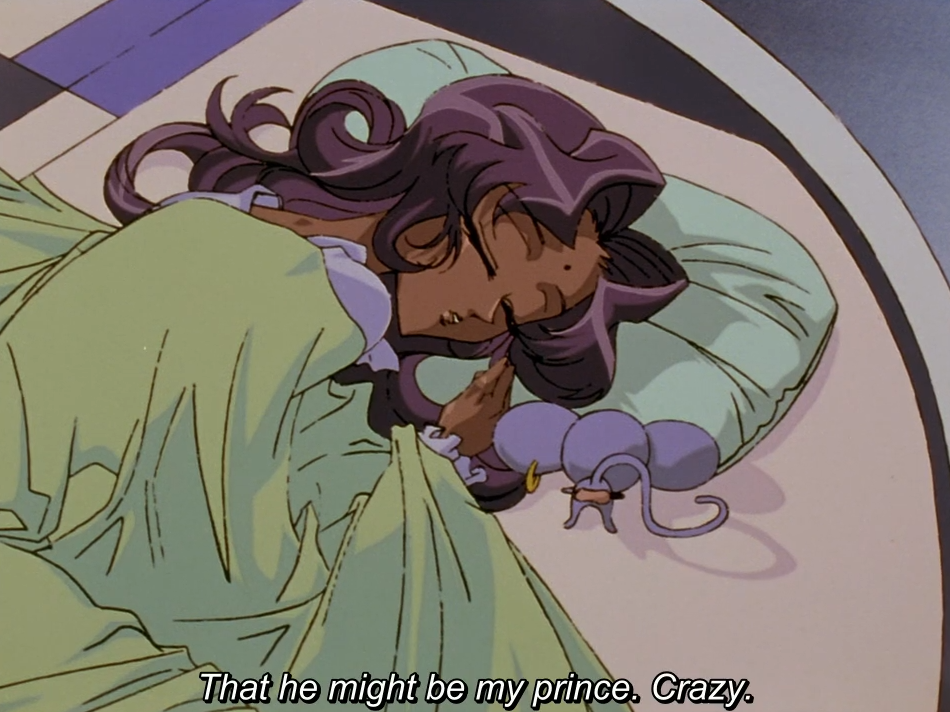
Utena: It’s funny. When we first met, that’s what I thought. That he might be my prince. Crazy.
Japanese uses quoting in casual language heavily. There is lots of this kind of thing: って感じ and ということ and なんて to name a few. These may not necessarily quote something verbatim, though they often do, but instead create a phrase, and then use that phrase as a descriptor, or comment on the phrase as a whole. For example, here’s an example from the volleyball anime Haikyuu, where the #10 (who is much shorter than average for a volleyball player) is meant to be a distraction for the opponents:
とにかく、「あのちっこい10番がすげー」的な空気を作る。 それが大きくなればなるほど。
“That little #10” gets a big reaction. The bigger, the better. (Netflix subtitle translation)
We want to create the vibe of “That short #10 is incredible”. The bigger, the better. (a more direct translation showing how Japanese plays with the verb phrase)
なんて is another “quoting” word/particle, which dismisses the previous sentence as ridiculous. It’s often translated as “to think that [blah blah]”, but I really liked my translation of it here as “Crazy.” I thought I’d highlight it cause it’s fun!

やーやーやー遠からんものは音に聞け、近くば寄って目にも見よ!我こそは白馬の王子なり!
When I first heard this line I could barely make out the words because it sounded so unfamiliar. And if I’ve learnt anything about shadow play lines that have unfamiliar grammar over the past 35 episodes, it’s that they’re probably a quote from an old Japanese text. So I googled what I could make out and sure enough, it was a quote. It was a reference to, as far as I can tell, one of the most well known 名乗り in history (nanori, a boastful self-introduction in battle).
The quote is from The Tale of the Heike, an epic account from sometime before 1330 of a series of real battles and feuds between two warring clans. It was said after a dominating victory by one warrior over another. He placed his helmet on his spear and spoke the boast to show how decisive his victory had been. The Utena version roughly means “Listen closely, those who are far away! Come close and behold! This is who I am — the White Horse Prince!”
I agonised over this line for some time. I thought about using a direct translation, or an establish translation of the Japanese text, but I ultimately decided that it would be more meaningful to reference a similar text that has significance in English.
I originally thought to use a line from Henry V. I figured there had to be something I could use in the St Crispin’s Day Speech monologue, but nothing quite fit right! I scoured the rest of the play, but there wasn’t anything that came off as a righteous boast. I figured I’d need to look elsewhere, so after a bit of thinking I decided to look into Beowulf. It’s an old epic, just like the Tale of the Heike, and it’s full of boasting.
I chose the opening lines to Beowulf to use as the reference. They begin with an exclamation (“So!” vs やーやーやー), they come from an old epic, they’re a boast that allowed me to slot in the name of the White Horse Prince, AND they’re reasonably recognisable, though I’m sure there are people who won’t recognise them (much like the original Japanese reference).
Anya looked into the available translations of Beowulf and chose the most recognisable and popular one (by Seamus Heaney). I’m so grateful they made the effort to look into this. I’m not well versed in this sort of thing so I was so glad they were able to make up for my lack of knowledge and help create my ideal translation! Here it is:
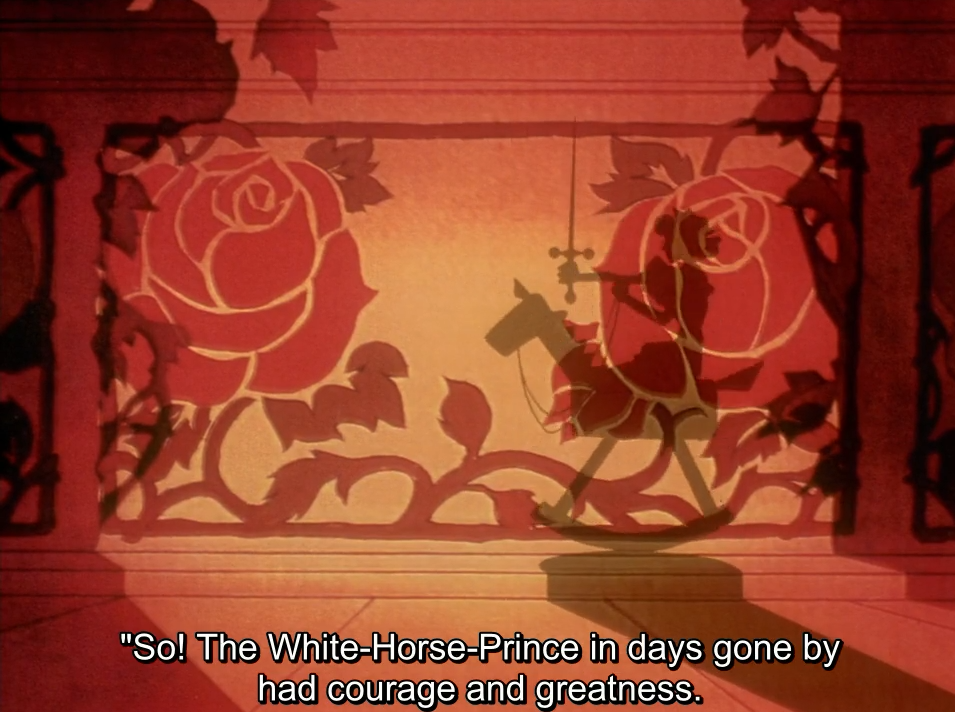
“So! The White-Horse-Prince in days gone by had courage and greatness. We have heard of this prince’s heroic campaigns!”
Thanks to my editor @dontbe-lasanya for the incredible work editing this episode!
To follow new releases as they come out, follow the blog! To see all episodes released so far, go here:
Haru Dipthong’s Utena Fansub - Google Drive
Rose divider taken from this post.