Utena Fansub Ep 19 Translation Notes
Revolutionary Girl Utena Episode 19 The Song Of The Fallen Kingdom.mkv
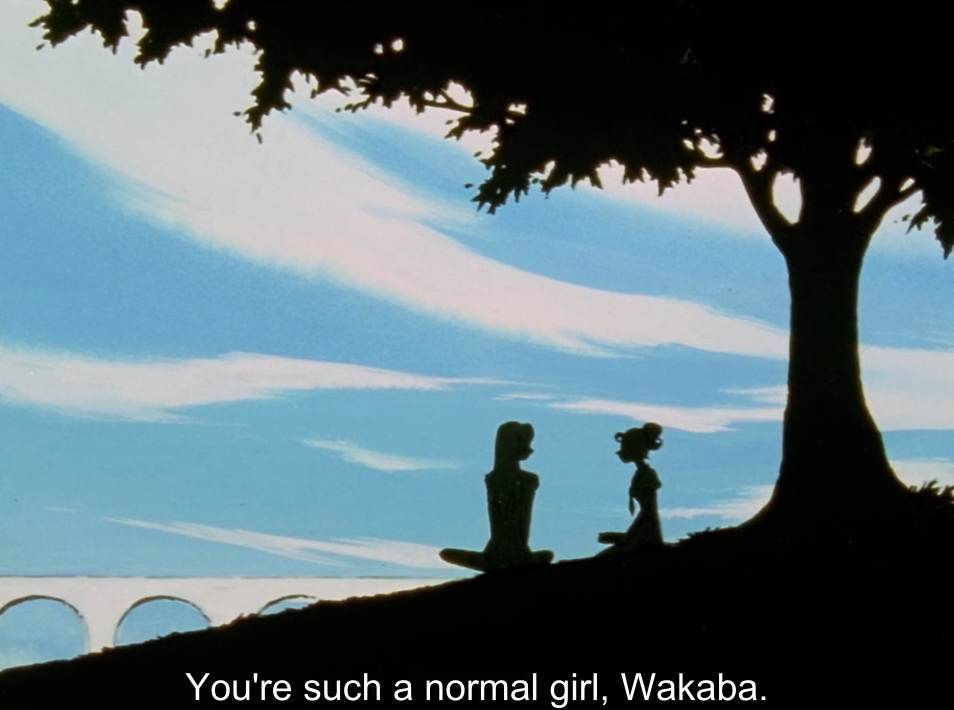
Utena: やっぱり若葉って普通の女の子なんだね。きっといいお嫁さんになるよ。
WHAT a loaded line. Let’s look at my translation of the first part:
Utena: You’re such a normal girl, Wakaba.
I think this line shows that at this point in the story, Utena has come to terms with the fact that they’re not a “normal” girl, but despite this self-recognition, they still see normalcy as something inherently good that one should strive for. They’re still in the clutches of an idealised status quo. Now let’s look at the next part. A literal translation would be:
Utena: I’m sure you’ll make a good bride. (from ohtori.nu)
But like… who says it like this in English anymore? While this phrasing sounds natural in Japanese, it sounds extremely old fashioned and weird in English. How would a native English speaker voice the same thought? I think it would be something like this:
Utena: You’ll probably make some guy very happy. (my translation)
This means the same thing, but sounds much more natural. This is another example of how to be a good translator, you need to be a good writer. You can’t just transpose words of the same meaning, you have to understand the thought behind the words, and then write a new sentence with the same thought behind it, but in the target language.
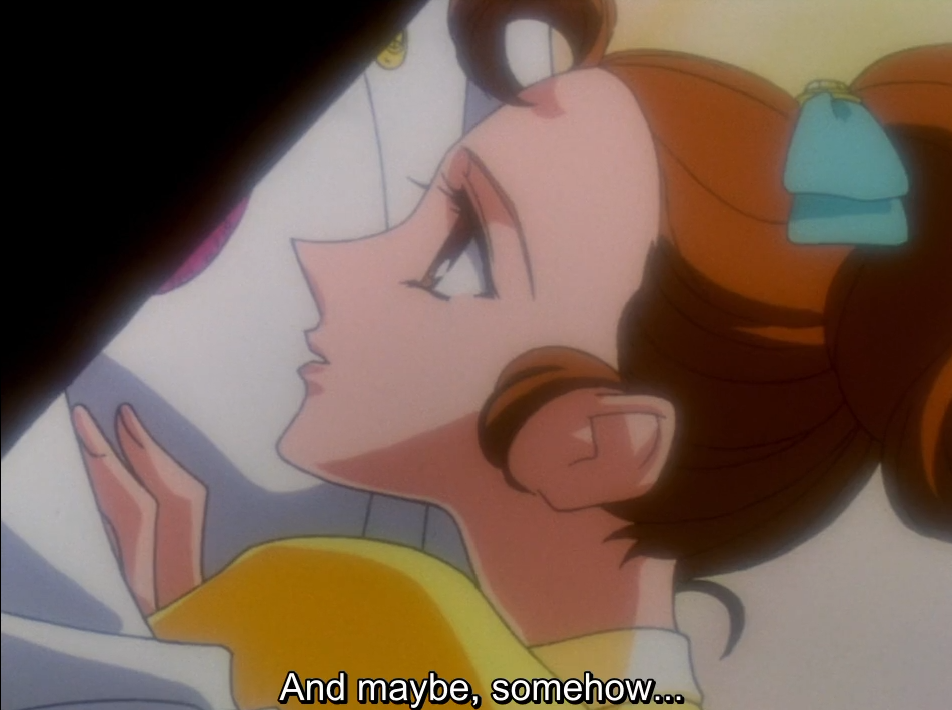
Wakaba: そうよ。ようやく気づいたの。やっぱり私はあの王子様が好きなんだって… そして、神様のおかげで王子様もやっと私の事振り向いてくれるようになったのかなって。
Wakaba: You’re right. I finally realised. I do love that prince of mine. And maybe, somehow… Something will finally happen between us.
There are a few things I want to talk about in this passage. First of all, 神様のおかげで. This is a phrase that literally means “because of the kami-sama (/positive)”. It’s often translated as “thanks to God” or “by the grace of God” or “thanks to divine intervention”, but to translate it this way is to erase the nuances of Japanese religious custom and worse, Christianise a non-Christian character.
In Japanese culture, Shinto and Buddhism are seen by the vast majority of people not as religions, but as customs. According to several surveys, approximately 70% of Japanese people specify they have no personal faith, despite statistical research showing that about 70% of Japanese people practice Shinto rites and practices, and another 70% of Japanese people practice Buddhist practices. This is because Japanese people follow these practices as a matter of culture and custom, not of faith. Participation rates in 初詣 (hatsumode), the first shrine visit of the year, are extremely high despite many participants not truly believing in the spiritual aspect. In Japan, Shinto and Buddhism are more about tradition and participation than faith and affiliation. And this is just based on anecdotal evidence from my own life, but I think a lot of Japanese people wouldn’t be able to explain the difference between Shinto and Buddhist belief systems. They all get blended together as part of the culture. Shinto and Buddhism ARE Japanese culture. The teachings of those religions inform the Japanese way of looking at and interacting with the world, despite the spiritual elements not being directly believed by many Japanese people.
On top of that cultural background, the concept of “kami-sama” (or just “kami”) are not God, or even gods. Generally, Shinto kami are more spirit than god, with kami said to inhabit everything from ancient trees to ramen bowls. In a way, they’re like the essence of the world. One could even say they are “the universe”, in the same way that secular English speakers might say “the universe is trying to tell me something”.
I don’t believe this line is showing that Wakaba is a believer in Shinto. It’s just showing that she believes that the universe is rotating in a favourable way for her. The “kami-sama” that she mentions are not literal kami or gods, but simply an indication that, through no direct action of her own, something good is happening to her (I have confirmed this interpretation with my dad, who is Japanese and was raised in Japan).
Wew… okay. Onto the second thing I wanted to talk about in this passage LOL
王子様もやっと私の事振り向いてくれるようになった
The final translation for this line was:
Something will finally happen between us.
But a more literal translation would be:
He’s finally looking my way.
In fact, I actually liked this more. I thought the imagery from the original Japanese was nice, and it translated directly quite well. The only problem was that pesky pronoun…
As Anya rightfully pointed out, you could read this as a setup for Utena being Wakaba’s prince. Certainly it’s all there in the text — Wakaba did repeatedly insist that “it’s not like that” between her and Tatsuya, she often treats Utena like a boyfriend, and it would even explain her getting flustered after Utena pressures her to reveal who her “prince” is at the lunch table. And let’s not forget Tatsuya’s line “I noticed that she looks the happiest when she’s with you, Utena.”
Some of this exchange had to be rewritten to completely avoid using any singular pronouns, lest we spoil the reveal at the end. For example, this line had to be changed from a focus on the prince to an indirect line about the both of them. I think the line still captures the general sentiment, but it’s a shame it had to change so much from the original phrasing!

Thanks to @dontbe-lasanya for the amazing editing, especially for picking up the pronoun issue when talking about the prince!
Follow my blog if you’d like to stay up to date with new episode releases! You can see all episodes released so far here:
Haru Dipthong’s Utena Fansub - Google Drive
Rose divider taken from this post