Utena Fansub Ep 12 Translation Notes
Revolutionary Girl Utena Episode 12 For Friendship, Perhaps.mkv
私たちも今までいろいろやってきた、疲れたわね
We’ve been so busy the last few episodes. I’m pooped.
A juicy little indulgence on my part here - the fourth wall break here by the shadow girls does not actually exist in the Japanese (explicitly). I’ll explain why I added it.
Here’s a very literal translation of the individual words above with no thought given to context or adjusting for grammar.
We (also) | until now | various different things | have done up to this point
I believe いろいろやってきた (lit. we’ve done various different things up to this point) is referring to their various performances in a sort of meta way. If we take each appearance of the shadow girls as a semi-in-universe mini stage play, this line is referencing the presence of previous plays within the current play. They’ve played pirates, plate spinners, cowboys, an educational program, and more! Acknowledging these things is tantamount to a performer acknowledging the fact that they’re an actor rather than a character while on stage, so the fourth wall break felt appropriate.
Anya was also happy with the fourth wall break and added that it emphasises the episode as a turning point and helps close out the arc, which I really agree with!
—–
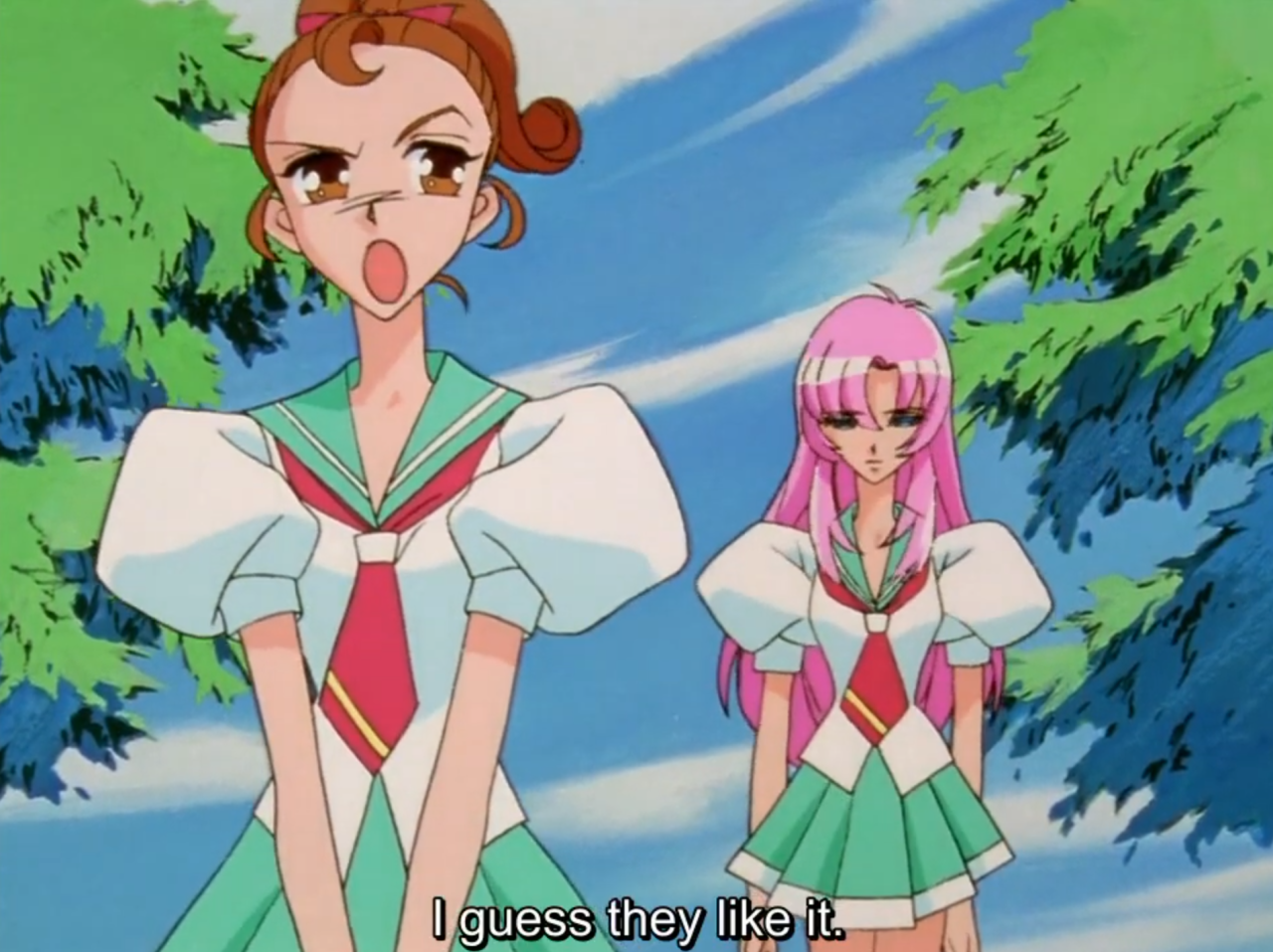
また黙秘するわけね。今のウテナってかっこ悪いよ。何か取られた腑抜けみたい。なんだかわからないけど、取られたら取り返しなさいよ!
Are you clamming up again? You look pathetic right now. Like you let someone steal from you! I don’t know what it was, but if someone took something from you, take it back!
Couple of little things to discuss about this line:
かっこ悪い is often translated as “uncool” or “lame”. This can sometimes be accurate, since it’s the opposite of かっこいい (lit. cool), but in this circumstance those words don’t hit hard enough. This かっこ悪い is more barbed than usual, so I kept the barbs by choosing a different word: pathetic.
“Clamming up” was an off the cuff choice because I felt I’d used “be quiet”, “not talk”, etc too many times in the previous scene to reuse them here. I think it fits with Wakaba’s personality and the current situation pretty well! 黙秘 is defined by jisho.org as “remaining silent; keeping secret”.
腑抜け means “coward” or something similar. I tried phrasing this line a few times to get that word in somehow, but in the end the whole rant just read so much better without forcing it in. Also cps (characters per second) was a concern here.
—–
元気な友達がいるね。
Your friend has quite the personality.
元気 (genki). What a word! Often translated as “energetic”. So often in fact, that even before I checked, I knew that the ohtori.nu translation would have used it, and sure enough!
Your friend is very energetic. (from ohtori.nu)
Along with “eyesore” and “confession (of love)”, this might take the bronze medal for common Japanese words that consistently get translated into very uncommon English words.
Of course, 元気 can literally mean “having a lot of energy”, or simply “well” (as in the opposite of “unwell”). But “energetic” is just such a bad translation for it 90% of the time. I wish I could convey why in words, but in most contexts, the word 元気 and the word “energetic” just feel so different.
Anyway, 元気 has quite a positive nuance, which emphasises the passive aggressiveness of Touga’s comment. The intent with this line is that he’s giving a vague compliment to Wakaba, indirectly (talking about her as if she’s not there), and making it clear that he wishes she wasn’t around. Everything else about the line should be secondary, including the specific meanings of each word.
I think this is emblematic of my general approach to translation — to identify the author’s original intent of a line/scene/work and then write it in a different language with the same intent in mind. Every line, every scene, is trying to do something — I believe it’s the translator’s job to identify what each line and scene is supposed to be doing and preserve that, so media literacy is very important. Sometimes that line is doing exposition, in which case a literal translation of each word is often ideal. Sometimes that line is trying to evoke a feeling, establish a character, or make the audience remember similar experiences, in which case the individual words used matter much less. In this case, the line is attempting to invoke memories of similar experiences of passive aggressive, dismissive comments. And frankly, “Your friend is very energetic” does not do that, so I consider it a poor translation.
—–
Thanks as always to my ride or die @dontbe-lasanya for their awesome editing this episode (and every episode!)
Make sure to follow the blog for episodes as they’re released. Go here for all previous episodes: