Dandadan Fansub Ep 11 Translation Notes
I love translating Jiji’s dialogue so much, because it’s such a challenge. It represents a new register to translate for! We’ve had formal teen register (Okarun), typical teen register (Momo), and exaggerated teen register (Curse Okarun). Jiji represents a fourth and final step into linguistic depravity… the YouTuber register. The way he talks is very reminiscent of certain Japanese YouTubers such as SkyPeace and Hikakin.

It’s so… eughhh. For research, I actually watched some Dude Perfect, Mr Beast, and random Minecraft YouTubers to get a feel for the dialect, and I found that they actually speak in that exaggerated way quite infrequently (as do the Japanese equivalents!) but they still carry that イメージ, that reputation. Here are some of my favourite Jiji lines from the episode:

もも!キャワウィイイーね!
Momo! Lookin’ foiiiiiine!
I wanted the stupid-sounding way he says “kawaii” to come through in the English, hence “foine” instead of just “fine”.

とりあえずハグしとく?
Where’s my hug?
“Where’s my hug?” is such an annoying guy thing to say that I was overjoyed when the Japanese script threw me such a softball. I guess annoying guys in Japan say similar stuff as annoying guys in anglophone countries.
Jiji (to the class): 一緒に住んでます!
…
Momo: おい、やめろ!変な噂立つだろうが!
…
Jiji (to the class): ラブの… (pause for dramatic effect) ラブです!
Jiji (to the class): We’re living together!
…
Momo: Dude, shut up! I don’t want rumours going around!
…
Jiji (to the class): We’re… (pause for dramatic effect) down bad.
The ラブです line cracks me up so much. It’s such a short utterance that only allows for a few characters’ worth of English text in the subtitle, but (as Mark Rosewater says) restrictions breed creativity, and I love the solution it forced me into.
Translating romance terms from Japanese to English is always surprisingly fraught. Surprising because if the translator thought about the translation for more than a minute, it wouldn’t be that hard, but you end up seeing terrible translations all the time. You’d think translators would be able to exercise a bit of context-based discretion, but in many cases you get direct translations, even calques that completely ignore the context in which the phrase is being said. This episode is a particularly egregious example, because one of these appears right in the title! 初恋 — “First Love”. By itself, a fair translation. But let’s look at the context it appears in:
Okarun: どちら様ですか?
Seiko: あいつはな、ももの幼なじみで… 初恋相手だ。
Okarun: Who is that?
Seiko: Him? He’s a childhood friend of Momo’s… and her first crush.

In context, it’s talking about how Momo felt about Jiji in primary school. You can’t translate that as “first LOVE” unless, I dunno, he like saved her life or something. The way they talk about their time in primary school together makes it clear that it was a simple childhood crush — Jiji wasn’t even aware of it, and they didn’t even talk to each other that much when they knew each other! Translating this as “first love” is simply incorrect and it makes me quite upset that it’s part of the official translation.
[Mild spoiler warning for season 2 for this next note]
Seiko uses the word 天才 to describe Jiji whenever he compliments her looks or her food. In most situations (and in the official translation), this word is translated as genius, and sure. I would certainly use the word 天才 to describe the likes of Hawking, Einstein, and da Vinci. But I don’t think it’s the right translation for this situation. “Genius” (the noun) is a more specific word than 天才. Their meanings overlap like the below Venn diagram.
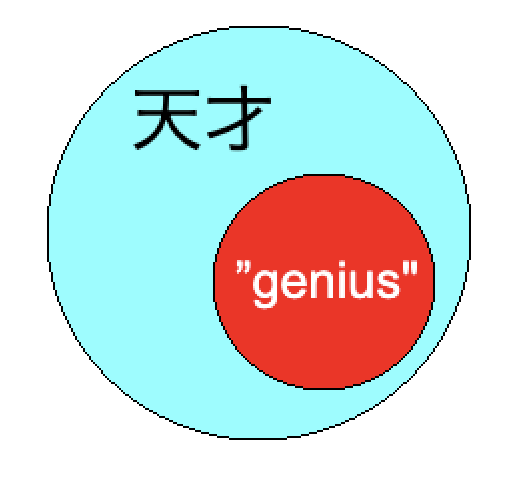
In this context, Seiko calling Jiji 天才 is saying “Damn kid, you know just what to say.” In this case, the “genius” is more like a natural charm, and I did translate it as “you’re a natural” originally before revising it.

Another meaning that 天才 can have is “someone with latent, inborn talent”. You wouldn’t call a child a “prodigy” before they started showing evidence of their abilities, but for some reason Japanese has more of an emphasis on latent talent. Maybe it’s because of a stronger emphasis on nature rather than nurture in Japanese culture, maybe it’s because, in anime, power levels are often quantified and discernible even before a character takes any action. In the above context, 天才 has an additional hidden meaning — Seiko is actually complimenting Jiji on his immense latent spiritual power, as revealed in a later episode + flashback to these scenes.
Given all that, I chose to translate it as “gifted” or “you have a gift”. I think this is much more natural sounding than “genius” in the original charm context, and works better as a reveal for later.